Genesis
The task set before me, was to design a piece of furniture for the bedroom (excluding beds, drawers and wardrobes). The allowed materials were:
- 6mm Plywood (2400mm X 1200mm)
- 2mm Coloured Palletone (100mm X 100mm)
Besides a new bed, the only piece of furniture my room actually needed, was a new display for my sword collection. It is a strange thing to collect, but it is almost pointless to do so unless the collection can be displayed in some respect. Part of my old sword rack can be seen below:

I made this many years ago when I built my first 3D printer. The mounts and feet are 3D printed and the uprights are simply two pieces of wood painted black. This rack had many problems; firstly it was not well balanced, simply removing a sword from the display would teeter the whole assembly as it threatened to topple. Another issue which faced me, was the lack of space. Once I had acquired more than three swords, I had run out of mounts. Without a functioning 3D printer, I was unable to find a home for my new sword, Anduril.
Design Process
I initially set out to create a weapons rack similar in style to my existing one. However, I wanted it to be modular, to have interlocking mounts which could be added and subtracted as I needed. In all honesty, this would have been plenty possible, had I had a little more time to figure out the design. Infact, I got pretty close before deciding that, while the product would function as I wanted it to, it would not be very appealing to the eye.
My next approach was to create a flat board similar to a coat rack which would hold the swords vertically by their hilts instead of horizontally by their blades. This would be considerably easier to finalise a design and have a lower risk of it not functioning.
But a coat rack, which works as I described, is an inherently simple shape.
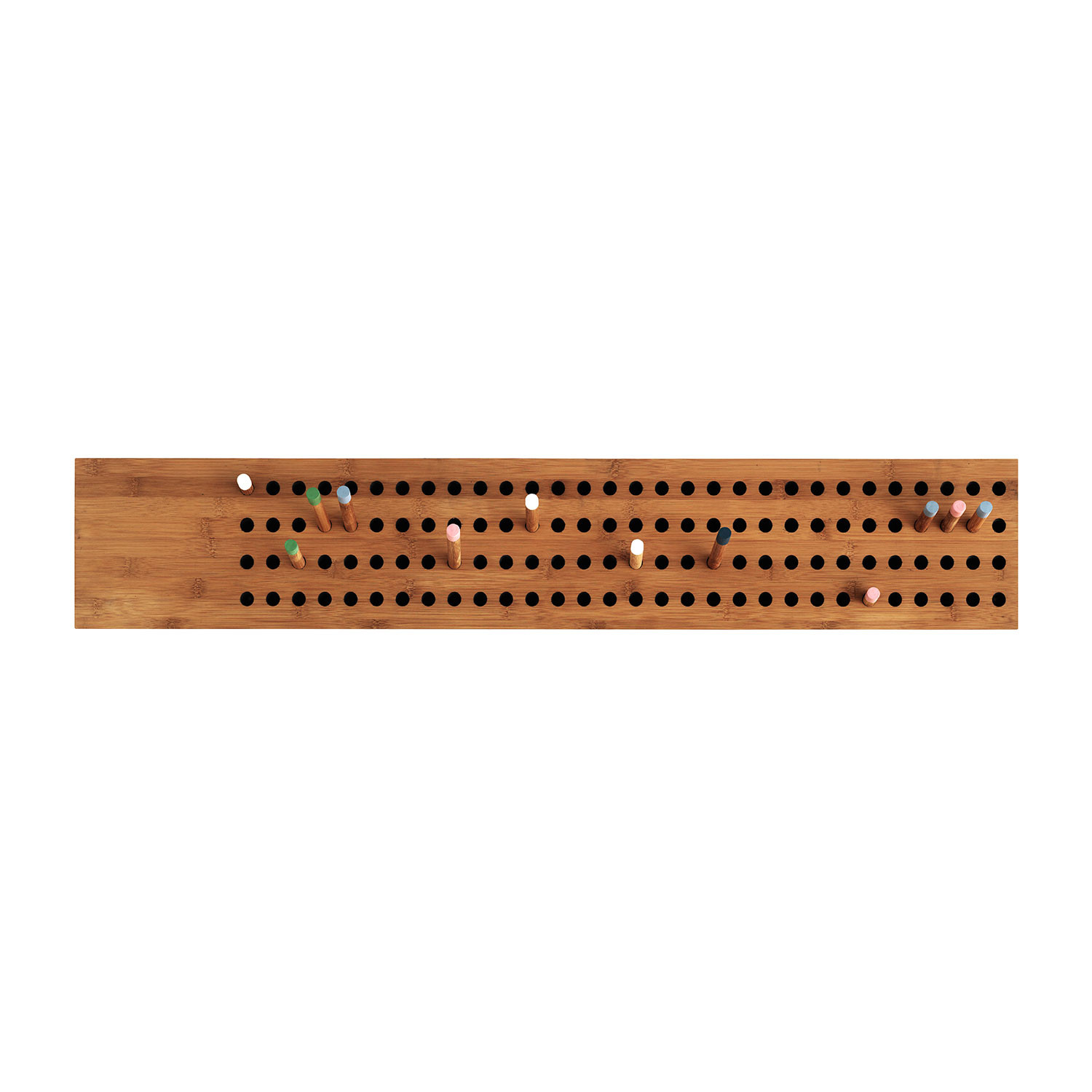
If I was to make a rectangular board, I wanted it to be slightly more interesting visually.
I did some research into the use of the Golden Ratio in furniture design and decided I would use these well tested proportions in my design.

The legs were my lecturer's idea, to make the item truly a piece of knockdown furniture. Mounting the board to the wall was my original idea but it is too much of a permanent solution. The legs simply elevate the board so the hilts are at eye level, and then the entire assembly slightly leans against the wall. Similar in fashion to this chair:

With the design finalised (within 24 hours of conception), I sent my files to be CNC'd. While waiting for the technicians to get to my job (last on the list) I began conducting some experiments on the palletone.
Manufacture
I wanted the pegs to have a tightly wrapped layer of palletone around the outside of the dowel. We milled a slot in a piece of 25mm dowel, cut a strip of palletone and fed it into the machined slot. This took quite a lot of effort before it slid in, but once it was in I used a heatgun to shrink the gap between the plastic and the dowel and was left with a very satisfyingly clean result.

This experiment proved successful so I cut a slot into a large length of dowel and then sliced it into 8 pieces on the bandsaw. I also made a quick jig to consistently make the dowels which would join the sheets of ply together.


The CNC cut with no issues. I have become an expert on the limitation of this machine during my tenure. I usually like to push the limits, but this time I kept my concepts quite tame.

The holes for the pegs were deliberately left too small because I didn't want to risk the pegs being loose. I taped a sheet of sandpaper to a dowel which i sudo-fit into a drill to open up the holes. This took a lot longer than I anticipated.


Next I moved onto the palletone details. These grooves needed some widening and tidying, so a piece of sandpaper was able to do the trick.


Starting to look real good. I should add that I rubbed a single layer of
E X T R A V I R G I N O L I V E O I L
over the plywood pieces just to give it a slightly darker tone.
I next had to decide on what pattern to put on the thick panel across the top of the piece. I thought perhaps a set of Fibonacci spirals made from circles would look really great.

There was no way I had the patience, precision, or time to hole punch so many holes. So I tried to simply cut out the shape with a knife.

Utter rubbish. Something simpler was needed. I found a 28mm hole punch (or thereabouts), measured out the correct distances, and did this within 5 minutes.


You beauty. That's all that was needed. All I had to do was finish the pegs and assemble.
I used the disc sander to taper the pegs slightly so they would fit into their holes a lot easier.


The CNC cut with no issues. I have become an expert on the limitation of this machine during my tenure. I usually like to push the limits, but this time I kept my concepts quite tame.

The holes for the pegs were deliberately left too small because I didn't want to risk the pegs being loose. I taped a sheet of sandpaper to a dowel which i sudo-fit into a drill to open up the holes. This took a lot longer than I anticipated.


Next I moved onto the palletone details. These grooves needed some widening and tidying, so a piece of sandpaper was able to do the trick.


Starting to look real good. I should add that I rubbed a single layer of
E X T R A V I R G I N O L I V E O I L
over the plywood pieces just to give it a slightly darker tone.
I next had to decide on what pattern to put on the thick panel across the top of the piece. I thought perhaps a set of Fibonacci spirals made from circles would look really great.

There was no way I had the patience, precision, or time to hole punch so many holes. So I tried to simply cut out the shape with a knife.


You beauty. That's all that was needed. All I had to do was finish the pegs and assemble.
I used the disc sander to taper the pegs slightly so they would fit into their holes a lot easier.

They also needed a flat piece of palletone to hide the ugly detail at the front. I learnt at this point that palletone can be very easily cut with scissors.


These circles were epoxied to the pegs.
I used a thinner piece of dowel to help me hammer in all the joining dowels. This allowed me to get a very flush finish.

Once the legs were on, I was done!


I used a thinner piece of dowel to help me hammer in all the joining dowels. This allowed me to get a very flush finish.

Once the legs were on, I was done!


Reflection
It was very satisfying to see come together within such a short production time. I'm quite proud of this one. Thank you Anna for all the extremely useful advice you gave to me in such a condensed period of time.
If I could change something about the design, it would be to somehow allow for additional weapons to be hung if they were eventually acquired. I didn't quite achieve my original goal of having the product be modular and I might have to rethink the whole concept if I ever get another sword.
I also would have loved to have the swords displayed horizontally, but it adds a whole new level of complexity especially as the point of the blade is a different width to the shoulder of the blade, making a perfectly horizontal sword a difficult accomplishment.
However this was a very rewarding course and I enjoyed it extremely.
Luke Timpani
2018

No comments:
Post a Comment